Reflecting on Two Decades: The Journey of My Abandoned Blog
Created:
Introduction
In 2023, I archived gedit.net, my first personal blog that I started in 2003 and abandoned in 2011. This post reflects on two decades of web development history and what those 20 years taught me.
TL;DR:
- Writing matters more than perfecting the technology
- Document everything you learn to find topics to write about
- Sharing is the core idea behind the web
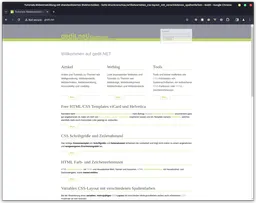
Journey
Why I Started and How I Learned
I started the blog for the following reasons:
- To learn and experiment with new technologies (SEO, HTML, CSS, JavaScript, PERL, SSI, PHP, CMS, etc.).
- To document my learning process and share it with others.
Summaries were, and still are, my go-to tool for reflecting and learning new things. I started this habit in secondary school and perfected it during my Abitur. I also shared summaries with others, thinking they would find them useful. The feedback I received helped me learn even more.
By nature, I am curious and interested in everything up to a certain level.
Consuming shared summaries, however, is like copying someone else’s homework — you don’t learn as much as the writer does. It’s more of a shortcut to the writer’s knowledge.
These days, I no longer share summaries. Instead, I share links to interesting articles and tools, write about what I learn and do, and share examples and code. Summaries are still part of my process, but now I keep them as README.md files in GitHub repositories, focusing on functionality rather than perfection.
The same applies to blogs, how-tos and tutorials.
Short History
Before the final version (v0.5) of the blog, I went through several iterations:
- v0.1: Designed to look like an MS-DOS Editor, created with Photoshop and ImageReady. It used CSS 2.0, iframes, and a fixed-position layout.
- v0.2: My first original design.
- v0.3: The first version developed without ImageReady slices. It introduced CSS 3.0 and was inspired by the Le Corbusier Color System.
- v0.4: Introduced new technologies like SSI, CGI/PERL, the blosxom Weblog, and CSS 3 float layouts.
- v0.5: A redesign and migration to phpSQLiteCMS. I also focused more on web standards and accessibility.
Looking back, I realize my focus was heavily on design and technology. If I could do it again, I would prioritize content and writing to better connect with my audience.
Technology-wise, it moved from static HTML 4.0 Transitional & CSS 2.0 in 2004 to SSR HTML 4.01 Strict & CSS 3.0 in 2008.
What Stands Out Today
From today's perspective, the following things stand out as curious:
Content & Writing
- Writing in English was challenging for me, so I wrote in German. Writing in German was also challenging and time-consuming because I held myself to high standards.
- I was already focused on web standards and accessibility.
- Most articles included examples and code.
- Every article was a how-to or tutorial—there were no opinions or reviews.
- I wrote about HTML5 as early as 2011.
- My focus leaned too heavily on design and technology over substance.
Technology Choices
- The website had almost no JavaScript.
- It supported Internet Explorer 6, 7, and 8.
- There were no CSS or JavaScript frameworks used.
- I used Opera as my main browser (the one with the Presto Engine).
- SCiTE was my text editor of choice.
- I experimented with adding the MIME type
application/x-httpd-phpto.cssfiles to dynamically generate CSS. - The site had no mobile support.
- I chose HTML 4.01 over XHTML 1.0, even though XHTML was gaining popularity at the time.
- I used a custom document type for HTML 4.01.
- In some versions, I used Apache SSI (Server Side Includes) for dynamic content.
Still Relevant Today
- I still listen to Pink Floyd 1.
- I still use concepts like HTML entities, RGB colors, and font stacks.
- I still use some of the tools I created for the blog.
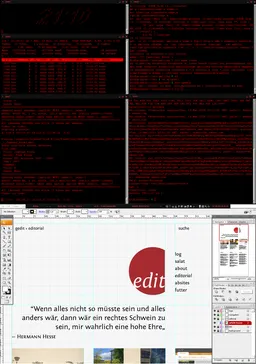
Screenshot of Redesign v0.6 in Photoshop (never finished) from 2010. The screenshot shows playing Pink Floyd's "Jugband Blues" in the background while working on the redesign in Photoshop.
Why I Abandoned the Blog
In 2007, I got my first jobs as a System Administrator and Developer. I worked on many different projects, learned a lot of new things, and continued working on my own personal projects.
At work, I wrote a lot of technical documentation and how-tos, so I didn’t feel the need to write for my blog anymore. My personal projects grew very slowly. While I finished some of them (the redesign v0.61 was not one of them), I forgot to share my knowledge on the blog.
Additionally, I didn’t keep track of all the technology powering the blog. I was too busy with work and personal projects, and I didn’t have time to maintain the blog. For example, the phpSQLiteCMS project was abandoned in 2009, and I didn’t have time to migrate to another CMS.
Instead, I started using other platforms:
- Twitter to share links to interesting articles and tools.
- GitHub to share examples, code, tools, and projects.
- Gists to document and share examples and how-tos.
Over time, the blog became less of a priority, and I eventually abandoned it.
Why Archive the Blog?
In 2023, I decided to archive the blog. The last post was more than 10 years ago, and I felt it was time to take action. I ultimately chose to archive rather than delete it for several reasons:
- It's interesting to see how I started with web development and design.
- It shows how the web has evolved over the last two decades.
- It reflects my growth as a developer.
- From time to time, I still use some of the tools I created for the blog.
- One of my goals for 2023 was to re-engage with writing, and archiving the blog was a good starting point.
Archiving gave me the space to reflect on two decades of growth. Writing this post has been the perfect way to close that chapter and start a new one.
20-Year-Old Technology
Here’s a list of the technology I used for the blog:
- HTML 4.01 (not XHTML 1.0): I chose HTML 4.01 over XHTML 1.0, even though XHTML was gaining popularity at the time. I validated the markup and used strict mode. I also experimented with custom document types but wasn’t sure if they would work with XHTML 1.0, so I stuck with HTML 4.01.
- CSS 2.1: CSS 3 was still a draft, but many features were supported by major browsers at the time, so I used them.
- WCAG 1.0: Although WCAG 2.0 was published in 2008, I used WCAG 1.0, likely because a validator existed for it.
- PHP 5.2: I used phpSQLiteCMS 2.0.42, a lightweight CMS written in PHP. The project has been abandoned since 2009.
- SQLite 2: This was the database version supported by phpSQLiteCMS. It was easy to use and didn’t require a database server. However, SQLite 2 is no longer supported, and I had to parse the database binary when archiving the blog.
- Smarty: I used this template engine with phpSQLiteCMS because it made templating easier and faster.
- Pound 2: I used Pound as a reverse proxy with SSL termination because Varnish didn’t support SSL. SSL wasn’t widely used at the time, but I wanted to learn more about it.
- Varnish 2: I used Varnish as a caching HTTP proxy to experiment with caching and filtering. While the blog didn’t need caching, I used Varnish to cache dynamic files, modify headers, and switch backends for static files.
- Apache 2: I used Apache as the main HTTP server with PHP-FPM/FCGI to serve
.phpfiles. I also wanted to learn more about mod_rewrite and.htaccessfiles. - Nginx and thttp: These were used to serve static files. Over time, I switched to using only Nginx because it was easier to configure for my use case.
- Debian 5 (Lenny): I initially used Debian 5 as the server OS to learn more about Linux server administration, security, and configuration. Before 2009, the blog ran on a dedicated server with Gentoo Linux.
- VPS Hosting: I hosted the blog on a VPS from HostEurope. It was affordable and allowed me to learn about DNS, SMTP, IMAP, FTP, SSH, and other protocols, and server administration.
What Content Did I Create?
The blog primarily featured tutorials and how-tos—learning artifacts that captured what I was discovering at the time. It also included:
- A Weblog where I shared links to interesting articles and tools.
- An Articles section with in-depth guides and tutorials.
- A Tools section with utilities I created, such as:
- A font stack generator.
- An RGB color picker.
- An HTML entity picker.
I focused on depth over volume. Each post was an artifact of my learning journey, and many remain useful and relevant today.
Conclusion
Archiving the blog was a great decision. It allowed me to reflect on:
- How I started blogging.
- How the web has evolved over the last two decades.
- How I’ve grown as a developer and as a person.
Writing and sharing remain as important to me today as they were 20 years ago. This journey has been a valuable reminder of the importance of documenting and sharing knowledge. If you have an old project gathering dust, consider archiving it instead of deleting it—you may find unexpected value in revisiting where you came from.
Key Lessons & Takeaways
On Writing & Creation:
- An article is never finished. It's a snapshot of your knowledge at a specific point in time.
- Investing time in writing a post is a better investment than tweaking the blog's software.
- Tweak the blog's software only if it directly serves your content.
- Focus on substance over presentation—the technology is secondary.
On Learning & Sharing:
- I found it easier to find things to learn when I read everything that interested me.
- I found it easier to find topics to write about when I documented everything I learned.
- I found I could write about anything by understanding it as part of my learning process.
- Share good resources you find online — you'll thank yourself later when you need them again.
- Share the idea behind your work, not just the code.
- Sharing is the foundation of the World Wide Web. It remains a silent revolution.
Before and After
Then: I optimized for perfection in design and code. I created my own zola theme before writing a single post. I held myself to impossibly high standards for every article.
Now: I optimize for consistency and impact. Writing comes first. Tools and design serve the content, not the other way around. Done is better than perfect.
Future
This blog will also be archived someday, and I'll probably write about that too. But until then, I'm committing to writing regularly—sharing lessons, thoughts, and experiences rather than just technical how-tos.
Early on, I focused on technology and tooling before content. This time, the writing comes first.
There's also an article about the archiving process if you're interested in doing the same.
References
I think it is phpSQLiteCMS version 2.0.4. Because I did regular updates. But I have no proof for that. The CMS is still available on SourceForge. The project is abandoned since 2009.
Feedback
Have thoughts or experiences you'd like to share? I'd love to hear from you! Whether you agree, disagree, or have a different perspective, your feedback is always welcome. Drop me an email and let's start a conversation.
<the-journey-of-my-abandoned-blog@exiguus.blog>