Dear Football Men, Don’t Be Offended
Created:
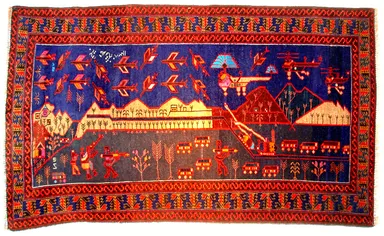
Picture by Weltalf. Wikimedia (https://commons.wikimedia.org/wiki/File:Collection_Till_Passow_Battle_for_Bagram_in_2001.jpg) / CC BY-SA 3.0 de (https://creativecommons.org/licenses/by-sa/3.0/de/deed.en)
How the DFB perpetuates sexism and why it’s time for real change in German football
Afghan war rug from western Afghanistan, measuring 90 x 150 cm. It depicts the attack on Taliban positions in Bagram in October and November 2001.
Introduction: Two Sides of the Same System
“Liebe Fußballmänner, nicht beleidigt sein.” (“Dear football men, don’t be offended.”)
With this line, musician Ikkimel confronted the audience of ZDF Morgenmagazin1 in July 2026—and was met with awkward silence, averted eyes, and even disapproval. The reaction was telling: In a football nation that prides itself on modernity and openness, direct criticism of the "football men" falls on deaf ears. Or worse: it meets resistance.
Just days later, Rudi Völler, DFB sports director and a powerful "old white man" in German football, demonstrated how deeply entrenched the very structures Ikkimel criticized still are. Instead of analyzing the tactical or strategic failures of the national team’s World Cup exit, he blamed Lena Nagelsmann, the head coach’s wife, for the team’s downfall—simply because she appeared in a photo at training.23
This reveals the double standard in German football: While artists like Ikkimel call out patriarchal patterns, the powerful men at the DFB perpetuate them—often unconsciously. Women are either instrumentalized as scapegoats or treated as victims, but rarely as equal actors. The DFB, which encompasses both figures, represents a system that has been dominated by old white men for decades—a system that officially condemns sexism but often turns a blind eye or even reinforces it in practice.
The DFB: Between Lip Service and Structural Inertia
1. The Power of Old White Men
The German Football Association (DFB) presents itself as progressive: task forces against discrimination, statements condemning sexism, and campaigns for diversity. But reality tells a different story. Power within the DFB still lies with a homogeneous group of old white men who make decisions without their own privileges and biases being questioned. This is evident not only in personnel decisions but also in the rhetoric and actions of its leaders. Rudi Völler’s remarks about Lena Nagelsmann are just the latest example: instead of addressing structural issues, women are blamed.2
2. Recent Sexism Incidents: a System That Fails to Protect Women
In recent months, the DFB has repeatedly failed to protect women in football and to consistently combat sexism:
| Case | Incident | DFB’s Response | Evaluation |
|---|---|---|---|
| Marie-Louise Eta (Union Berlin, 2026-04) | Sexist abuse on social media | Condemnation, but no preventive measures | Symbolic, no consequences |
| Fabienne Michel (Referee, 2025-03) | Sexist chants from fans | Investigations only after public pressure | Reactive, not preventive |
| Heiko Vogel (U23 Coach, 2021-01) | Sexist remarks | Fine, stadium ban, coaching sessions | Case-by-case sanction, no systemic change |
The pattern is clear: The DFB only acts when public pressure becomes too great—and even then, usually with half-measures. Instead of questioning the power structures that enable such incidents, it relies on case-by-case solutions. A long-term strategy against sexism and for genuine equality is missing.34
3. Anti-Discrimination Work: Much Noise, Little Impact
The DFB has established task forces against discrimination and issued statements, but the results are meager:
- No comprehensive educational campaigns in clubs or among fans.
- No binding quotas for women in leadership positions.
- No independent investigations into structural sexism within the association.
- No consequences for officials who make racist or sexist statements.
Instead, a culture of impunity prevails: Those in power remain in office—even if their statements, like Völler’s, show they either do not understand or are unwilling to solve the problems.
Conclusion: the DFB Must Act—Radically
The cases of Ikkimel, Völler, and the recent sexism scandals show: German football has a structural problem. As long as power remains with the "football men" who either ignore women or use them as scapegoats, nothing will change. The DFB has the opportunity to take a leading role—but so far, it lacks the will to question its own structures.
Three Concrete Demands
-
Rudi Völler must resign. His statement about Lena Nagelsmann is not just embarrassing—it is symptomatic of a system that does not take women seriously. Anyone who reproduces such narratives has no place in a leadership position.
-
Immediate 50% women’s quota in all DFB bodies. The association needs parity representation in boards, committees, and decision-making bodies. Only then can the culture change sustainably.
-
A binding diversity strategy with clear goals and sanctions. The DFB must publicly and bindingly commit to diversity, equality, and anti-discrimination—and actively promote these values. Those who violate them must face consequences.
German football deserves better. It is time for the DFB to stop hiding behind empty words and finally follow through with action. Women in football are no longer waiting.
ZDF Morgenmagazin is one of the most-watched morning television shows in Germany. ZDF Morgenmagazin
Feedback
Have thoughts or experiences you'd like to share? I'd love to hear from you! Whether you agree, disagree, or have a different perspective, your feedback is always welcome. Drop me an email and let's start a conversation.
<liebe-fussballmaenner-nicht-beleidigt-sein@exiguus.blog>